Eating Disorders In Athletes | Dish With A Dietitian

As I work with my clients, I strongly suggest working with a registered dietitian during recovery. There are times when questions surface during session that can be better answered by a dietitian rather than an eating disorder therapist. Dietitians are an integral part of an eating disorder treatment team. Registered dietitians are educated professionals who know about not only food but also the way nutrition interacts with our unique bodies along with how nutrition can help improve our overall wellbeing. It can be helpful to learn about how to explore adding a registered dietitian to your treatment team and the impact eating disorders can have on you as a female athlete. This post will help you learn more about eating disorders in female athletes and how to find out more about the recovery process.
Each month, New Directions Colorado features a dietitian to help answer various questions you have. The goal of these blog posts is to familiarize yourself with dietitians, have additional recovery resources and to ask questions in a format that may feel less intimidating before scheduling a session with them.
Having the task of finding the right fit in a provider (i.e. mental health therapist, dietitians, psychiatrists and medical doctors) for your unique goals and needs can be overwhelming. Not all providers will be a good fit for you. We completely get that and want you to be successful in your recovery. Listen to your intuition on the right fit. Now, let us move forward to today’s guest dietitian!
Caila Yates, MS, RDN | Steady State Nutrition

Colorado Based Registered Dietitian Nutritionist helps answer questions from individuals who struggle with eating disorders and disordered eating.
Recovery from disordered eating and eating disorders can become much easier with trained professionals including mental health therapists, physicians, registered dietitians and psychiatrists.
HOW DO YOU DISTINGUISH BETWEEN DEDICATED TRAINING WITH REQUIRED EATING AND DISORDERED BEHAVIORS?
This is a nuanced distinction, and one that often requires looking beyond what someone is eating to how they’re relating to food. Two key factors I typically assess when differentiating performance-driven fueling from disordered eating are rigidity around food and the presence of food noise.
While many athletes are cognizant of what their needs are to fuel for their sport, there is a difference between being intentional with intake and being rigid with it. Intentional fueling allows for flexibility and adaptation. For example, an athlete may comfortably eat out, choose something satisfying from the menu, and still build a balanced plate without significant stress. Conversely, someone with a rigid mindset often struggles with the uncertainties and loss of control that comes with going out to eat, such as someone else cooking and plating their meal or a deviation from a “typical” dinner. If these situations consistently provoke anxiety, avoidance, or distress, that can signal emerging or active disordered eating patterns.
Now for “food noise,” I’m referring to the chatter that may be in one’s mind that may sound something like, “I shouldn’t have eaten that” or “what can I eat to help me lose weight?”. Food noise is commonly associated with underfueling, heightened body image concern, and restrictive patterns. When fueling is adequate and flexible, food tends to occupy less mental space. In contrast, persistent food noise often indicates that the body and mind are not getting what they need, and that eating behaviors may be driven more by fear or control than by performance or health.
Together, rigidity and food noise point to useful clinical signals for distinguishing between disciplined athletic fueling and disordered eating behaviors.
HOW DO YOU EXPLORE AN ATHLETE’S RELATIONSHIP WITH FOOD AND THEIR BODY ALONGSIDE THEIR SPORT?
I start by asking open-ended questions about how athletes think about fueling, body changes across training cycles, performance pressures, team culture, coaching messages, and how much mental space food and body occupy day-to-day. I’m listening for markers like rigidity versus flexibility, the presence of food noise, fear of weight or body changes, and how much identity and self-worth are tied to body size or performance.
I also assess how their relationship with food and body shifts over time – during the off-season versus in-season, during injury, high-stress periods, or transitions in training load. These moments often reveal whether fueling and body image are adaptive and resilient, or whether they become more controlling, anxious, or restrictive under stress.
This work also creates an opportunity to challenge harmful norms within sport culture that equate control, leanness, or pushing beyond limits with success. Supporting athletes in developing a more flexible, compassionate relationship with food and body not only improves individual outcomes, but contributes to healthier team environments and long-term cultural change in sport.
HOW CAN AN ATHLETE EMBRACE HEALTH AT EVERY SIZE (HAES™) OR INTUITIVE EATING WHEN SOME SPORTS PROMOTE LEAN PHYSIQUE?
A common misconception is that athletes must follow rigid meal plans, track macros, or conform to a specific body type in order to perform well. Not only is this untrue, but these approaches often increase rigidity, food noise, and anxiety around eating. Athletes are already inundated with so much data on a day-to-day basis, and I always say that nutrition shouldn’t be part of that.
HAES and intuitive eating shift the focus away from manipulating body size and toward supporting physiological needs, performance, and long-term sustainability. Rather than prescribing strict plans, I often recommend a plate-by-plate or Athlete’s Plate approach, which emphasizes balanced proportions of carbohydrates, protein, fats, and fruits/vegetables on each plate. This framework provides enough structure to support training demands while still allowing athletes to tune into hunger, fullness, satisfaction, and day-to-day variability in needs.
What’s powerful about this approach is that it scales naturally: whether the plate is larger or smaller on a given day, the proportions remain consistent. This supports adequate fueling without requiring tracking or perfection. It also translates well to real-world settings like travel, dining out, or team meals — situations where rigid plans often break down and increase stress.
Ultimately, athletes can absolutely honor HAES™ and intuitive eating principles while pursuing high performance by prioritizing nourishment, flexibility, and internal cues over body control and external rules. This creates a more resilient relationship with food and a more sustainable foundation for both health and sport.
HOW DO YOU NOTICE EATING DISORDERS AND/OR DISORDERED EATING IN ATHLETES?
First, I use validated questionnaires to screen all of my athletes for eating disorders and Relative Energy Deficiency in Sport (RED-S), which gives me insight into one’s behaviors and physical symptoms. I also examine their latest lab values, as some biomarkers can be indicative of underfueling, hormonal imbalances, micronutrient deficiencies, and physiological stress associated with eating disorders and/or RED-S.
HOW CAN ATHLETES EXPAND THE IDEA OF “FUELING FOR FUNCTION” AND EMBRACE FOOD AS MULTIFACETED FOR OVERALL WELLBEING?
I always say that every food has a function. Yes, even desserts like cookies and ice cream, which often get a bad rep among athletes. However, it’s important to think about all foods as being made up of nutrients that are helpful to athletic performance and overall daily function.
Let’s take ice cream, for example. Sure, maybe we don’t want to eat ice cream right before a big competition, as it may cause some GI distress. BUT, it’s absolutely part of a balanced diet. Ice cream has carbohydrates that act as quick energy for your body, and can be stored in your muscles as glycogen for use during practice or competition. It has fat, which helps with meeting high energy needs, aids the absorption of certain vitamins and minerals, and supports hormone balance. And, as a dairy product, it contains calcium and vitamin D, which of course, help with maintaining bone density and preventing stress injuries.
It’s so easy to classify foods as “healthy” or “unhealthy” in a black-and-white way. However, I always encourage my clients to think about foods as a means of connection, celebration, and joy, while still acknowledging that all foods have benefits to them.
HOW DO YOU IDENTIFY AND WORK WITH RED-S?
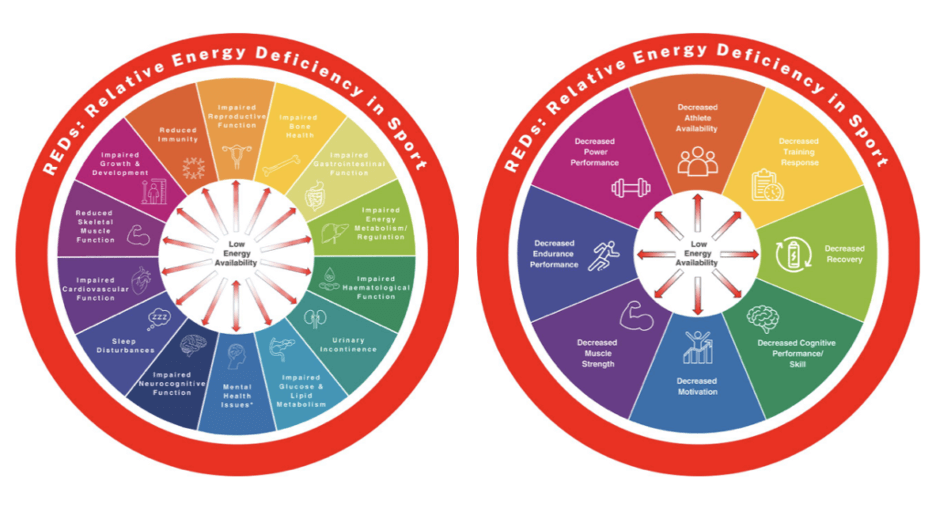
RED-S (Relative Energy Deficiency in Sport) is a clinical syndrome that occurs when an athlete does not consume enough energy (calories) to support the combined demands of training, daily living, and normal physiological functioning. While there is no fully validated RED-S screening tool, there is a lot of emerging research that helps clinicians like myself recognize it.
In the diagram below, you’ll see a number of signs and symptoms that an athlete may experience in RED-S, such as poor sleep, mood swings, GI issues, reduced immunity, decreased muscle strength, or loss of menses (for those who menstruate).
Now, of course, if someone has a bad night of sleep and poor recovery for a few days, that’s not going to warrant a RED-S diagnosis. It’s about looking at the larger picture – Is there a constellation of symptoms? Are the signs ongoing? How do the signs line up with training load and fueling habits? We can also use things like lab values and clinical conversation to put the pieces together as well.
It’s important to note that underfueling is not always intentional. In many cases, it reflects busy schedules, underestimated energy needs, appetite suppression from training, logistical barriers, or unintentional restriction – not necessarily an eating disorder. When working with someone experiencing RED-S, I focus on identifying the root contributors by reviewing dietary intake, training demands, daily structure, stress levels, access to food, and any anxiety or rigidity around eating.
From there, we work together to set up sustainable habits that fit into an athlete’s busy lifestyle that help them consistently meet their energy needs.
This might look like increasing the energy density of each meal and snack, incorporating fear foods that are more energy dense, or increasing the frequency of eating. The goal is consistent, adequate energy availability that supports recovery, performance, health, and long-term sustainability – not perfection or rigid rules.
HOW DO YOU ENCOURAGE CLIENTS WHO ARE IN COMPETITIVE AND PROFESSIONAL SPORTS TO PRACTICE JOYFUL MOVEMENT, IF THAT’S AN UNFAMILIAR CONCEPT?
Phew! This can be a tough one! Athletes are conditioned to compete – to always go harder, faster, or heavier. While that mindset can drive achievement, it can also crowd out the emotional and restorative benefits of movement. It’s SO important for athletes to partake in movement that is for joy – not performance – in order to fill up their cup emotionally.
I work with clients to understand what they love about their sport outside of competing or winning. For some, it’s the community they’ve built or the team traditions. For others, it’s being outdoors, problem-solving, or exploring new places. I challenge my athletes to find more activities that give them one or all of those peripheral benefits without the pressure, metrics, or expectations.
This could be gardening outside, walking their dog, doing yoga, or playing pick-up basketball. The goal isn’t to replace training, but to broaden an athlete’s relationship with movement so it includes joy, connection, curiosity, and recovery.
WHAT ARE SOME THINGS YOU ARE EXCITED ABOUT IN SPORTS NUTRITION?
I’m excited to see more women in research. For so long, female athletes have been underrepresented and misunderstood in academic research, and in the past few years, there has been an exponential increase in women-focused studies. All of this new information will only help providers like myself better understand the nutritional needs of female athletes and better personalize the care that we provide in order to make them more confident in fueling their bodies.
WHAT IS SOMETHING YOU ENJOY DOING IN THE WINTER AND SPRING MONTHS?
I definitely slow down and cozy up in the colder, darker months. I probably read triple the amount of books in the winter as I do in the summer because I love being under a blanket with my Kindle.
However, believe it or not, I do still love to run in the winter, as long as it’s with friends. It’s refreshing to bundle up, get outside, and be social, even when it’s cold out.
WHAT IS YOUR FAVORITE JOYFUL MOVEMENT AND WHY?
My favorite joyful movement is doing pottery on the wheel. I know it may not sound like movement, but it requires me to be present in my body, focused on my breath, and helps me let go of stress.
DO YOU ONLY WORK WITH ATHLETES?
No! I also work with non-athletes who have disordered eating habits, or simply want to work towards intuitive eating.
CAILA’S EXPERIENCE
Caila Yates, MS, RDN, has dual-expertise in sports nutrition and eating disorder treatment. Caila helps her clients reach their goals while maintaining a healthy relationship with food and their bodies. Having worked in multiple settings of eating disorder treatment, she is well-equipped to screen, treat, and support her clients no matter where they are on their recovery journey.
Connect With Caila
You can find out more about Caila’s services by checking out her website, social media or by connecting with her via email:
- Email: caila@steadystatenutrition.co

If you or someone you know is suffering from an eating disorder, contact an eating disorder therapist right away. Call 720-306-1631 to set up your free 30 minute consultation, where we can check in with what’s present for you and you may ask a trained eating disorder therapist any questions you might have. You may also learn more about eating disorder therapy offered by New Directions Colorado, here.
© Erica Faulhaber 2026 – This blog may be shared or reprinted as long as the information is unedited and the author bio, including contact information is printed along with the blog.
 Erica Faulhaber PhD, NCC, LPC, CEDS, EMDRIA Approved Consultant and Certified EMDR Therapist. She is a therapist in Erie, Colorado who helps women struggling with trying to be perfect all the time. New Directions Colorado, is a therapy practice that specializes in eating disorders/disordered eating, trauma and Eye Movement Desensitization and Reprocessing (EMDR).
Leave a Reply